



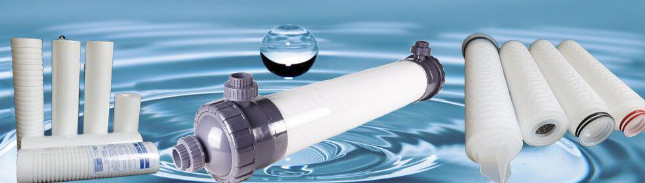
Microfiltration (MF), Ultrafiltration (UF), Nanofiltration (NF) and Reverse Osmosis (RO) are four mainstream filter membranes widely applied in the water treatment industry. Many practitioners and buyers cannot clearly distinguish their filtration precision, intercepted pollutants and applicable scenarios. This article sorts out their core differences in detail for your reference.
1. Microfiltration (MF)
Its filtration accuracy ranges from 0.1 to 50 micrometers. Common PP filter cartridges, activated carbon filter cartridges, ceramic filter cartridges all belong to the microfiltration category. It is adopted for simple rough filtration to remove large granular impurities such as sediment and rust in water, yet it cannot eliminate harmful substances like bacteria.
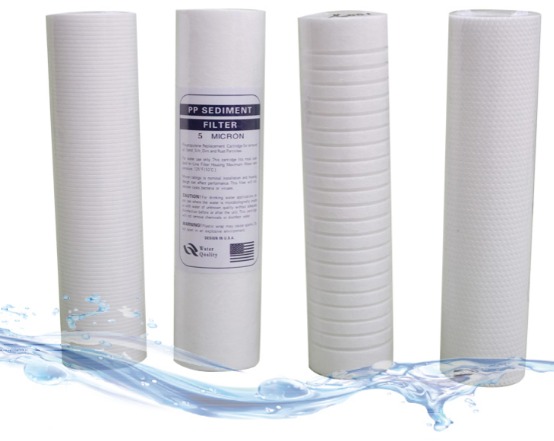
Most MF filter cartridges are disposable and non-cleanable, requiring regular replacement:
1. PP Cotton Cartridge: Only used for low-standard rough filtration to remove large particles including sediment and rust.
2. Activated Carbon: Able to remove color and peculiar smell in water, but ineffective in bacteria removal and performs poorly on sediment and rust interception.
3. Ceramic Filter Cartridge: Its minimum filtration precision is merely 0.1 μm, featuring small water flow and difficult cleaning.
2. Ultrafiltration (UF)
The filtration accuracy of ultrafiltration ranges from 0.001 μm to 0.1 μm, a high-tech membrane separation technology developed in the 21st century. It is a differential pressure-driven membrane separation technology. It can intercept rust, sediment, suspended solids, colloids, bacteria, macromolecular organics and other hazardous substances in water, while retaining mineral elements beneficial to human bodies.
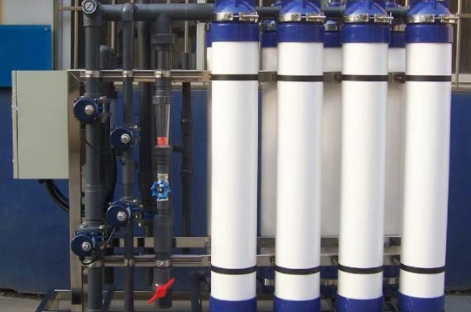
Ultrafiltration process serves as the core component for mineral water and spring water production. Its water recovery rate reaches over 95%. The equipment supports convenient flushing and backwashing, resists clogging and boasts a relatively long service life.
Ultrafiltration requires no power supply or pressurization; tap water pressure alone can drive filtration. It features large water flow and low operating cost, suitable for comprehensive purification of household drinking water.
Therefore, ultrafiltration technology will dominate domestic drinking water purification in the future. Combined with other filter materials, it can broaden the treatment range and thoroughly remove pollutants in water.
3. Nanofiltration (NF)
Its filtration accuracy is between ultrafiltration and reverse osmosis, with a lower salt rejection rate than RO. It is also a power-and-pressure-dependent membrane separation technology with low water recovery rate.
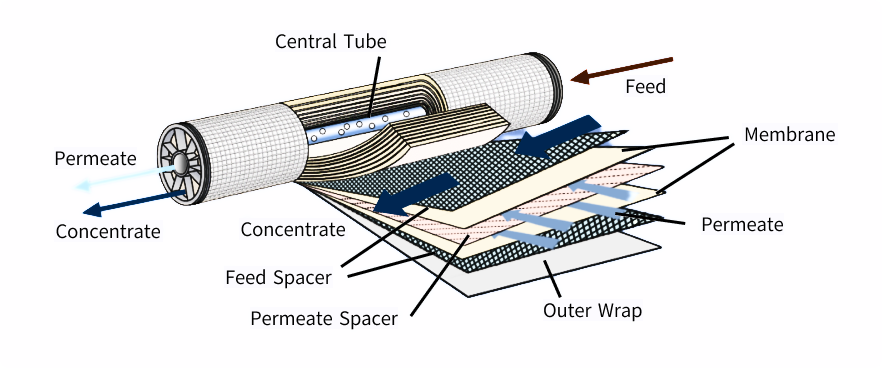
Around 30% of tap water will be wasted during nanofiltration water production, which is unacceptable for most families. Hence nanofiltration is mainly used for industrial pure water preparation.
4. Reverse Osmosis Membrane (RO Membrane)
RO is the abbreviation for Reverse Osmosis Membrane. Under natural osmosis, water flows from low-concentration side to high-concentration side. After applying pressure higher than natural osmotic pressure, water will flow reversely from high-concentration to low-concentration side, which is the core reverse osmosis principle.
The pore size of RO membrane is only 0.0001 μm (five one-millionths of a human hair). The size of bacteria and viruses is 5000 times that of RO membrane pores.
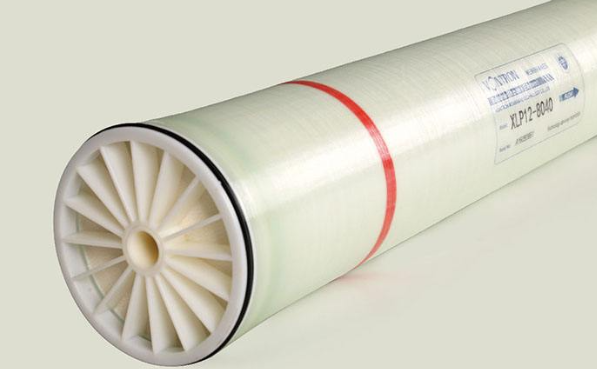
Only water molecules and partial mineral ions beneficial to human body can pass through the membrane. All other impurities and heavy metals are discharged through wastewater pipelines. Reverse osmosis technology is adopted for seawater desalination and astronaut wastewater recycling, so RO membrane is also known as a high-tech artificial kidney outside the human body.
Comprehensive Comparison Table of Four Types of Membranes
|
Comparison Item |
Microfiltration (MF) |
Ultrafiltration (UF) |
Nanofiltration (NF) |
Reverse Osmosis (RO) |
|
Filter Pore Size |
0.1μm |
10nm |
1nm |
0.1nm |
|
Common Membrane Material |
Polypropylene |
Hollow fiber, Polysulfone, Ceramic membrane |
Polyamide |
Polyamide composite membrane |
|
Membrane Structure Type |
Symmetric membrane |
Asymmetric membrane |
Asymmetric membrane |
Asymmetric membrane |
|
Operating Pressure |
- |
- |
Min 0.3MPa, normally 0.7MPa |
Up to 10.5MPa |
|
Typical Application |
Whey treatment, skimmed milk filtration |
Mineral water production, whey separation, brine filtration |
Desalination & de-sugaring of salty whey |
Concentration of ultrafiltration whey permeate, desalination, pure water production |
|
Flux [L/(m²·h)] |
High |
Medium-High |
Medium |
6~10 |
|
Lactose Interception Rate |
|
0.8~0.9 |
0.02~0.15 |
0.001~0.002 |
|
Cl⁻ Interception Rate |
|
1.0 |
0.25~0.9 |
0.02~0.06 |
|
Ash, K⁺, Na⁺ Interception Rate |
|
0.9~0.97 |
0.15~0.5 |
0.01~0.025 |
|
P Interception Rate |
|
0.8~0.95 |
0.04~0.25 |
0.0007~0.0025 |
|
Ca²⁺, Mg²⁺ Interception Rate |
|
0.8~0.9 |
0.03~0.2 |
0.0005~0.0015 |
|
Core Separation Principle |
Physical screening for large particles |
Pressure-driven screening to intercept colloids, particles and macromolecular substances; small solutes and water permeate the membrane |
1. Solution-diffusion 2. Donnan electrostatic selective interception of ions |
Apply pressure higher than natural osmotic pressure to separate pure water from salt-containing raw water, a dehydration technology |